Interchange fees affect nearly every Erie merchant that accepts credit cards, debit cards, online payments, mobile wallets, invoices, and POS transactions. These fees are part of the broader payment processing costs that appear on merchant statements and influence margins, pricing, cash flow, and daily profitability.
For many local businesses, card acceptance is no longer optional. Customers expect fast, secure, flexible payment options whether they are shopping in person, paying an invoice, booking a service, or checking out online. The challenge is that every card transaction carries costs, and interchange is usually the largest part of those credit card processing fees.
Understanding interchange fees for Erie merchants helps business owners see what they are paying for, why some transactions cost more than others, and how better payment habits can reduce avoidable expenses.
This guide breaks down interchange fees explained for Erie businesses, including pricing models, card-present vs card-not-present fees, debit card interchange fees, POS transaction costs, and practical ways to manage small business merchant fees.
What Are Interchange Fees?
Interchange fees are transaction fees connected to card payments. When a customer pays with a credit or debit card, the merchant does not receive the full sale amount without deductions. A portion of the transaction goes toward merchant processing fees, and interchange is one of the core pieces of that total cost.
In a typical card transaction, interchange is paid through the payment chain to the bank that issued the customer’s card. This fee helps support the cost and risk of card programs, including authorization, fraud monitoring, account management, rewards programs, and cardholder services.
The exact interchange amount can vary based on the card type, transaction method, merchant category, security level, and whether the payment happens in person or remotely.
For Erie business owners, the most important point is that interchange is not usually a single flat amount. It can include a percentage of the transaction plus a small per-transaction fee. That means both the sale amount and the number of transactions matter.
A small coffee shop with hundreds of low-ticket transactions may feel the fixed per-transaction cost more strongly. A contractor or professional service business with fewer high-ticket invoices may feel the percentage cost more strongly.
Retailers, restaurants, service providers, healthcare offices, nonprofits, and ecommerce sellers may all see different Erie merchant interchange fees because their transaction patterns differ.
Interchange is only one part of credit card interchange fees Erie PA businesses may see on statements. Other costs may include processor markup, assessment fees, monthly account fees, gateway fees, chargeback fees, PCI-related fees, equipment costs, and software fees.
For broader setup context, merchants can review this helpful payment processing setup guide for new Erie businesses.
How Interchange Fees Work for Erie Businesses
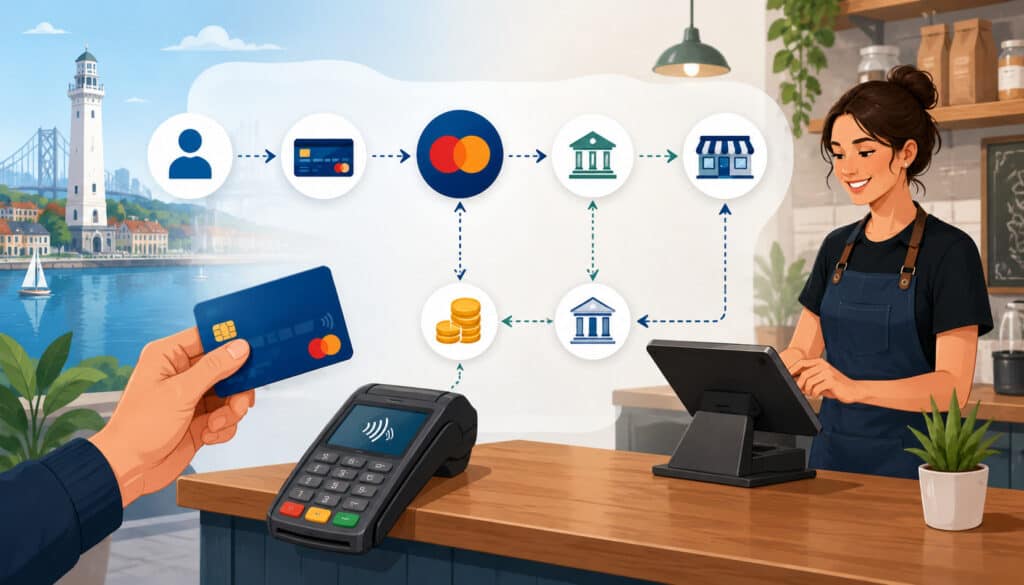
When a customer taps, dips, swipes, keys in, or enters card details online, a chain of communication happens in seconds. The payment starts at the merchant’s POS system, terminal, website, invoice link, or virtual terminal. From there, the transaction moves through a processor and payment network to the card-issuing bank for approval.
The issuing bank checks whether the account is valid, whether funds or credit are available, and whether the transaction appears suspicious. If approved, the authorization travels back to the merchant. The sale can then be completed, and the customer receives confirmation.
Later, settlement occurs. Settlement is when the transaction is finalized and funds are routed through the payment system. During this process, interchange fees, network fees, and processor fees are distributed.
The merchant receives the net deposit after applicable credit card processing fees and other merchant processing fees are deducted or billed.
This is why two sales with the same dollar amount may not cost the same to process. A chip card used in person may qualify for a lower-risk interchange category than a manually keyed phone order.
A basic debit card may price differently from a premium rewards credit card. A properly batched transaction may clear more efficiently than one submitted late or with missing data.
The table below summarizes common fee components.
| Fee Component | What It Covers | Why It Matters |
| Interchange fee | Amount associated with the issuing bank’s role in the transaction | Often the largest part of card acceptance cost |
| Network assessment | Fee connected to card network access and routing | Applies across many card transactions |
| Processor markup | Provider charge for processing, service, reporting, and support | This is often the negotiable part of pricing |
| Gateway fee | Online payment gateway or virtual terminal access | Common for ecommerce, invoices, and card-not-present payments |
| Chargeback fee | Cost tied to disputed transactions | Can increase losses beyond the original sale |
| Equipment or POS fee | Terminal, POS software, or hardware access | Affects long-term POS transaction costs |
Card-Issuing Banks and Payment Networks
Card transactions involve several parties. The issuing bank provides the card to the customer. The acquiring bank or merchant processor supports the merchant’s ability to accept payments. Payment networks connect the transaction between these parties and set many of the rules that govern authorization, routing, settlement, and dispute handling.
For Erie merchants, this matters because no single party controls every cost on a statement. Interchange is generally tied to network rules and card categories, while processor markup depends on the merchant services arrangement.
This is why understanding the difference between interchange, assessments, and markup is essential when comparing Erie payment processing solutions.
Issuing banks carry cardholder-related risk, especially on credit transactions where the customer borrows funds. Networks maintain acceptance rules, transaction standards, and routing systems. Acquirers and processors help merchants accept, transmit, settle, and report payments.
When all parties do their job well, customers experience a fast checkout. Behind the scenes, however, each transaction must meet technical and security requirements. Missing data, manual entry, outdated terminals, or weak fraud controls can push transactions into more expensive categories.
Credit Card vs Debit Card Interchange Fees
Credit card and debit card transactions can have different fee structures. Credit cards often carry higher interchange costs because they may involve credit risk, rewards programs, and different authorization rules. Premium rewards cards can be especially expensive compared with standard cards.
Debit card interchange fees may be lower in some cases, but they still vary. PIN debit, signature debit, regulated debit, exempt debit, card-present debit, and card-not-present debit may price differently depending on the transaction environment and applicable rules. The Federal Reserve provides detailed information about debit card interchange and routing under Regulation II.
For Erie small business interchange costs, debit acceptance can be helpful for certain transaction types, especially when customers are comfortable using debit for everyday purchases. However, merchants should not assume debit is always the cheapest option in every scenario.
The best approach is to review real statement data. Look at the card mix, ticket size, transaction count, debit volume, keyed volume, and online volume. This gives a more accurate picture than relying on general assumptions.
Card-Present vs Card-Not-Present Transactions
Card-present transactions occur when the customer and card are physically present, such as an EMV chip transaction at a checkout counter or a contactless tap at a terminal. Card-not-present transactions happen when payment details are entered online, over the phone, through an invoice link, or manually into a virtual terminal.
Card-not-present fees are often higher because these transactions carry greater fraud and dispute risk. Without a physical chip read or contactless token, the system has less certainty that the real cardholder is authorizing the payment. This is why ecommerce, phone orders, recurring billing, and manually keyed transactions may carry higher interchange costs.
For Erie businesses that sell online, send invoices, take deposits, or accept remote payments, card-not-present fees are part of doing business. The goal is not to avoid these channels entirely.
Instead, merchants should use security tools such as address verification, CVV collection where appropriate, tokenization, secure hosted payment pages, and clear refund policies.
Factors That Affect Interchange Fees for Erie Merchants
Several factors influence interchange fees for Erie merchants. These factors often work together, which is why merchant statements can look complicated at first. A transaction’s cost may depend on the card type, how the card was accepted, the merchant category, the sale amount, security data, and whether the transaction was submitted correctly.
Transaction type is one of the biggest drivers. In-person EMV chip transactions are usually treated differently from keyed or online transactions. Card-not-present fees often cost more because fraud risk is higher. Recurring payments may have their own categories, especially if the transaction uses stored credentials.
Card type also matters. A basic consumer card may not cost the same as a premium rewards card, commercial card, purchasing card, or corporate card. Rewards cards can carry higher costs because cardholder benefits must be funded somewhere in the payment system.
Business category is another factor. Restaurants, retail stores, professional services, lodging businesses, healthcare offices, contractors, ecommerce sellers, and nonprofits can fall into different merchant category codes. These categories may influence available interchange levels.
Ticket size matters too. For small-ticket merchants, per-transaction fees can add up quickly. For large-ticket merchants, percentage-based fees can have a bigger impact. A business with many low-dollar sales should pay close attention to fixed costs, while a high-ticket business should watch percentage costs and card mix.
Security features can also influence transaction handling. EMV chip terminals, contactless payments, tokenization, encryption, fraud filters, and proper authorization practices can help transactions qualify more cleanly. Weak security does not only raise risk; it can also contribute to chargebacks, downgrades, and avoidable losses.
Processing environment is equally important. A modern POS system can capture the right data, batch transactions properly, and reduce manual errors. An outdated terminal or inconsistent workflow may create extra costs over time.
For more comparison guidance, business owners can use this payment processing checklist for Erie business owners.
Common Pricing Models Erie Merchants Should Understand

Interchange is only one part of merchant pricing. The way a processor presents and bills fees can make a major difference in how easy it is to understand total costs. Erie merchants should know the common pricing models before comparing offers.
Interchange-plus pricing separates interchange, network assessments, and processor markup. This model is often considered more transparent because merchants can see the underlying interchange cost and the processor’s added margin.
For growing businesses, multi-location merchants, higher-volume retailers, and businesses with mixed transaction types, interchange-plus pricing can make statements easier to evaluate.
Flat-rate pricing charges a simple fixed percentage, sometimes with a per-transaction fee. It is easy to understand and may work for very small businesses or startups that value simplicity. However, flat-rate pricing can be more expensive if the processor’s blended rate is higher than the merchant’s actual transaction mix requires.
Tiered pricing groups transactions into categories such as qualified, mid-qualified, and non-qualified. While this can look simple at first, it may be harder to know why certain transactions fall into more expensive tiers. Merchants should be cautious when the rules behind each tier are unclear.
Subscription pricing generally charges a monthly fee plus a smaller transaction markup over interchange. This can work for some higher-volume businesses, but only if the monthly cost is justified by lower per-transaction margins.
Blended pricing combines multiple costs into one rate. This may be convenient, but it can make it harder to see whether Erie merchant interchange fees, processor markup, or other fees are driving cost changes.
When comparing pricing models, ask these practical questions:
- What is the total effective rate?
- Are interchange and assessments passed through separately?
- What is the processor markup?
- Are there monthly minimums?
- Are gateway, PCI, batch, statement, or support fees added?
- Are card-not-present fees priced differently?
- Are chargeback and retrieval fees clearly listed?
- Is equipment included, leased, rented, or purchased?
How Interchange Costs Affect Small Business Profit Margins
Interchange costs affect profit margins because they reduce the net amount a business keeps from each sale. For Erie merchants operating with tight margins, even small differences in payment processing costs can matter.
A retailer, café, salon, auto service shop, contractor, or professional office may accept dozens or hundreds of card payments each week. Over time, those costs can become a meaningful operating expense.
The impact is not only about total fees. It is also about predictability. If a business does not understand why one month’s processing fees increased, budgeting becomes harder. Seasonal volume, higher online payments, more rewards cards, more keyed entries, chargebacks, or pricing changes can all shift the effective rate.
Payment costs also influence pricing decisions. Some merchants build card acceptance costs into menu prices, service fees, product pricing, delivery fees, or invoice rates.
Others offer cash discounts or encourage lower-cost payment methods for large invoices. Any approach should be handled carefully, clearly disclosed, and aligned with applicable card rules and local requirements.
Cash flow is another issue. Card payments may settle quickly, but fees reduce net deposits. If a merchant has loan payments, payroll, inventory purchases, rent, utilities, taxes, or supplier bills due, unexpected processing costs can create pressure.
Small business merchant fees should be reviewed as part of regular financial management. A monthly statement review can reveal cost trends, higher-risk transaction patterns, unnecessary add-on fees, or opportunities to improve payment workflows.
Online Payment Costs
Online payment costs often differ from in-person costs. Ecommerce checkouts, invoice links, online deposits, recurring billing, and manually keyed payments usually fall into card-not-present categories. These transactions can carry higher card-not-present fees because the card is not physically read by a chip or contactless terminal.
For Erie businesses that rely on online invoices or ecommerce, these costs are not necessarily a problem. Remote payments can improve convenience, speed up collections, reduce missed payments, and serve customers who prefer digital options. The key is to make online payment acceptance secure and well-managed.
Merchants should use secure payment pages, avoid storing card data improperly, collect verification details when appropriate, and use fraud tools that match the business model. A contractor taking deposits may need different controls than an online store shipping products. A professional office collecting invoices may need different settings than a subscription business.
Strong online workflows can reduce disputes, improve reconciliation, and help prevent avoidable downgrades.
In-Person Payment Optimization
In-person payment optimization focuses on secure, efficient card acceptance at the point of sale. EMV chip terminals, contactless payment acceptance, mobile wallets, and integrated POS systems can help reduce manual entry and support smoother transaction handling.
For many Erie merchants, upgrading from outdated terminals can improve the checkout experience and reduce operational friction. A modern POS can track sales, taxes, tips, inventory, customer data, employee permissions, and reporting in one place. Integrated systems may also reduce duplicate entry and reconciliation errors.
In-person optimization is not only about cost. It also affects customer trust. Customers expect quick, secure checkout experiences. Contactless payments and chip readers can make lines move faster while supporting stronger authentication than manual entry.
Merchants can explore secure equipment and POS options through products and services for Erie businesses.
Ways Erie Merchants Can Reduce Interchange Costs
Reducing interchange costs does not mean avoiding card payments. Customers want payment choice, and many businesses depend on card acceptance for sales growth. The practical goal is to reduce avoidable costs while maintaining a smooth customer experience.
Start by encouraging lower-cost payment methods when appropriate. For large invoices, ACH may be a useful option. For everyday purchases, debit may sometimes cost less than credit, depending on the transaction and pricing structure. Customers should always have a convenient, clearly explained way to pay.
Use secure chip readers and contactless terminals whenever possible. EMV and contactless transactions reduce the need for manual entry and can support better transaction qualification. If your staff often keys cards because equipment is slow, unreliable, or unavailable, that can raise costs and risk.
Avoid manual card entry unless necessary. Keyed transactions can increase card-not-present fees and create more exposure to fraud and disputes. For phone orders or invoices, secure payment links are often better than writing down or typing card details.
Batch transactions correctly. Many merchants do not think about batching, but delayed settlement or poor batch practices can create problems. Closing batches consistently helps transactions clear properly and supports cleaner reporting.
Review statements every month. Look for changes in effective rate, new fees, higher card-not-present volume, increased chargebacks, non-qualified charges, batch fees, PCI fees, and monthly account costs. If something changes suddenly, ask why.
Reduce chargebacks with clear policies. Use accurate product descriptions, transparent refund rules, signed service agreements where appropriate, delivery confirmation, customer communication, and prompt issue resolution. Chargebacks are expensive because they can include lost revenue, dispute fees, labor, and inventory loss.
Improve data quality. Some transaction types require additional information to qualify correctly. Business-to-business, purchasing card, corporate card, and invoice transactions may benefit from better data capture.
Consider these practical steps:
- Use EMV or contactless acceptance for in-person payments.
- Send secure payment links instead of keying card numbers.
- Offer ACH for large invoices or recurring billing.
- Batch transactions at the proper time.
- Keep POS software and terminals updated.
- Train employees on correct checkout procedures.
- Review merchant statements monthly.
- Track chargeback reasons and fix recurring issues.
- Compare pricing models using effective rate, not only headline rate.
Common Merchant Fee Mistakes to Avoid
One common mistake is focusing only on headline rates. A processor may advertise a low rate, but the actual cost depends on interchange, assessments, markup, transaction fees, monthly charges, equipment costs, gateway fees, PCI fees, and other account charges. The true number to watch is the effective rate: total fees divided by total processed volume.
Another mistake is ignoring monthly statements. Many merchants only check deposits, not the full statement. This can allow fee increases, chargeback patterns, non-qualified transactions, or unnecessary services to go unnoticed. Reviewing statements does not have to take long, but it should be consistent.
Using outdated terminals is another costly issue. Older equipment may not support contactless payments, EMV standards, modern encryption, or software updates. Outdated tools can slow checkout and increase manual entry.
Weak payment security can also be expensive. Poor password practices, shared logins, unsecured devices, and improper card data handling can increase fraud exposure. Security failures can damage customer trust and create operational headaches.
Poor reconciliation is another avoidable problem. If deposits, refunds, chargebacks, tips, taxes, and processor fees are not reconciled properly, business owners may misunderstand cash flow. This can lead to pricing mistakes, tax reporting problems, or missed losses.
Misunderstanding pricing structures can create confusion. Flat-rate pricing may look simple but may not be cheapest. Interchange-plus pricing may look complex but may be more transparent. Tiered pricing may look organized but may hide why transactions are downgraded.
Merchants should also avoid signing long equipment leases without understanding total cost. A “free” terminal, rented terminal, leased terminal, or purchased terminal can each affect long-term cost differently.
Payment Security and Interchange Fees
Payment security and interchange fees are connected through risk. Secure payment practices can help transactions qualify properly, reduce fraud exposure, and lower the chance of disputes. While security tools do not eliminate interchange, they can support healthier processing and fewer avoidable costs.
PCI-aware workflows are essential. Merchants should avoid writing down card numbers, storing card data in unsecured systems, or sending card details through email or text. Staff should know how to handle payments safely and how to recognize suspicious activity.
Encryption protects card data while it moves through payment systems. Tokenization replaces sensitive card information with a token that can be used for future transactions without exposing the original card details. This is especially useful for recurring payments, stored customer profiles, memberships, and repeat invoicing.
Secure terminals matter too. EMV chip readers and contactless terminals provide stronger transaction data than magnetic stripe or manual entry. A secure POS environment can also reduce employee errors and improve reporting accuracy.
Fraud prevention should match the sales channel. Ecommerce merchants may need address verification, CVV checks, fraud scoring, shipping rules, velocity limits, and manual review for unusual orders. Service businesses may need signed authorizations, deposits, invoice documentation, and clear cancellation policies.
Security also supports customer confidence. When customers trust the checkout process, they are more likely to complete purchases and return. That trust is part of long-term revenue protection.
For businesses comparing secure local options, this overview of merchant services in Erie PA provides additional context on payment processing and POS solutions.
What are interchange fees?
Interchange fees are card transaction costs associated with the issuing bank’s role in a credit or debit card payment. They are part of the broader merchant processing fees that businesses pay when accepting card payments.
These fees usually vary based on card type, transaction method, merchant category, security level, and processing environment. For example, an in-person chip card transaction may have a different cost than a manually keyed phone payment.
Why do Erie businesses pay interchange fees?
Erie businesses pay interchange fees because card payments rely on a network of banks, processors, and payment systems. When a customer uses a card, the transaction must be authorized, routed, settled, and funded.
Interchange helps support the card-issuing side of that process. It is one of the core costs built into credit card processing fees and debit card acceptance.
Are interchange fees the same for all cards?
No. Interchange fees are not the same for all cards. A basic debit card, standard credit card, premium rewards card, business card, and corporate purchasing card may each carry different costs.
The transaction method also matters. Card-present, card-not-present, recurring, keyed, ecommerce, and mobile wallet transactions may fall into different categories.
Why are online transactions more expensive?
Online transactions are often more expensive because they are card-not-present payments. The card is not physically dipped, tapped, or read by an EMV terminal, which can increase fraud and dispute risk.
Ecommerce payments, invoice links, phone orders, and virtual terminal payments should use security tools such as address verification, CVV checks, tokenization, and secure hosted payment pages.
What is interchange-plus pricing?
Interchange-plus pricing separates the underlying interchange and assessment costs from the processor’s markup. This makes it easier to see what portion of the cost comes from card networks and issuing banks versus the processor.
Many merchants like interchange-plus pricing because it is more transparent than bundled or tiered pricing. However, the best fit depends on transaction volume, business type, card mix, and operational needs.
Can businesses lower interchange costs?
Businesses cannot usually negotiate the base interchange categories directly, but they can reduce avoidable costs. Better payment practices can help transactions process more efficiently and reduce risk.
Useful steps include using chip or contactless terminals, avoiding manual entry, batching properly, reviewing statements, reducing chargebacks, and offering ACH for suitable invoice payments.
How do debit card fees differ from credit card fees?
Debit card interchange fees may differ from credit card fees because debit transactions pull funds from a bank account, while credit transactions involve a credit line. Debit and credit cards can also follow different network rules and pricing categories.
However, debit is not automatically cheaper in every case. Merchants should review real statement data to understand how their debit and credit card mix affects total payment processing costs.
Why should businesses review merchant statements regularly?
Merchant statements show how much a business is paying, which fees apply, and whether costs are changing. Regular reviews can uncover higher card-not-present volume, chargebacks, new monthly fees, non-qualified transactions, or pricing issues.
A monthly review also helps business owners make better decisions about pricing, payment methods, POS tools, and cash flow planning.
Conclusion
Understanding interchange fees for Erie merchants helps business owners manage payment processing costs with more confidence. Interchange is a major part of card acceptance, but it is not the only cost.
Merchant processing fees can also include network assessments, processor markup, gateway fees, POS transaction costs, chargeback fees, and monthly account expenses.
The most important step is visibility. When Erie merchants understand how credit card interchange fees Erie PA businesses encounter are affected by card type, transaction method, security, pricing model, and processing environment, they can make better decisions.
Secure payment practices, transparent pricing, modern POS tools, careful statement reviews, and smart payment options can help reduce unnecessary costs. For small businesses, even modest improvements can strengthen margins, improve cash flow, and support better long-term financial planning.